https://allbrandsrefrigeration.com
24/7 Emergency Commercial Refrigeration Repair — Western Washington

24/7 Commercial Refrigeration Repair — Seattle, Tacoma & Western Washington

When commercial refrigeration fails, the problem can quickly become more than an equipment issue. Rising temperatures can put inventory at risk, interrupt operations, create compliance concerns, and turn a developing problem into an expensive emergency.

AllBrands Refrigeration specializes in commercial refrigeration. Our technicians diagnose and repair the refrigeration systems businesses depend on to protect temperature-sensitive products and keep operations running throughout Western Washington.

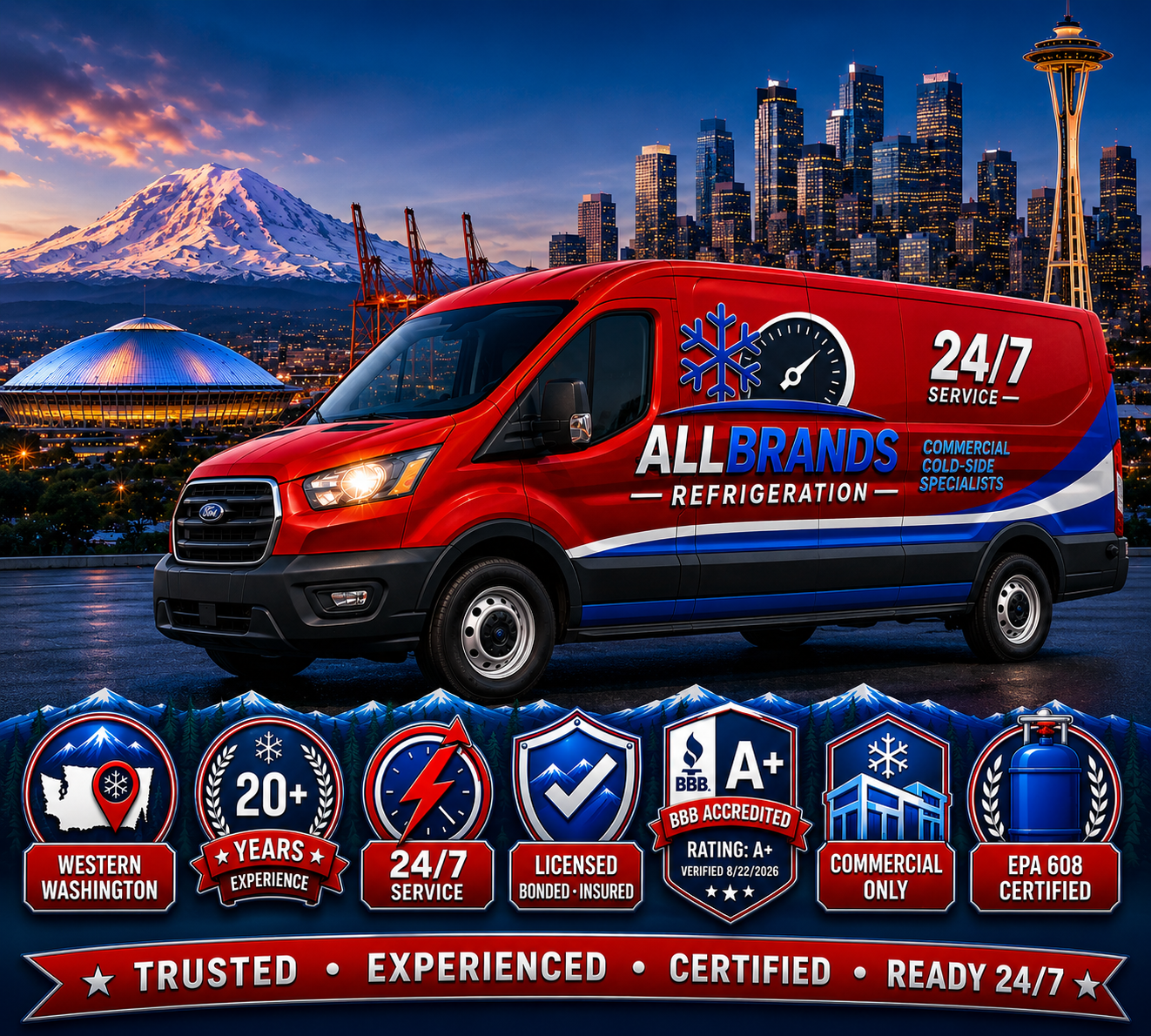
AllBrands Refrigeration 24/7 emergency cooler and freezer service van with Seattle and Tacoma skyline
AllBrands Refrigeration credentials: 24/7 emergency service; commercial only; licensed, bonded and insured; EPA 608 certified; serving Western Washington; BBB accredited with an A+ rating verified 8/22/2026; and more than 20 years of experience.

Swipe to view all credentials

  • 24/7 Emergency Service
  • Commercial Only
  • Licensed, Bonded and Insured
  • EPA 608 Certified
  • Serving Western Washington
  • BBB Accredited Business — Rating A+ (Verified 8/22/2026)
  • 20+ Years Experience

Regional Operating Conditions

How Western Washington Conditions Affect Commercial Refrigeration

Commercial refrigeration equipment in Western Washington operates in a demanding combination of moisture, seasonal temperature changes, coastal exposure, and outdoor conditions.

Understanding those conditions matters when diagnosing recurring icing, electrical problems, refrigerant-system issues, corrosion, and premature equipment failure.

Marine Humidity, Coil Icing & Defrost Problems

Western Washington's persistent humidity, rainfall, coastal fog, and moisture intrusion can contribute to condensation and frost accumulation in walk-in coolers and freezers.

As ice builds on an evaporator, airflow can become restricted, cooling capacity can fall, and box temperatures can begin to rise.

Instead of treating the elevated temperature as the entire problem, AllBrands Refrigeration evaluates evaporator condition, airflow, defrost scheduling and termination, heaters, sensors, door conditions, and related controls to determine why the icing is occurring.

Temperature Changes & Refrigeration System Performance

Changing outdoor temperatures can significantly alter the operating conditions of rooftop condensing units, remote refrigeration systems, and walk-in equipment.

Under some conditions, refrigerant migration, oil return, expansion-valve operation, floodback, and compressor protection can become important parts of the diagnosis.

Our technicians evaluate the refrigeration system under its actual operating conditions rather than assuming that a symptom has the same cause in every season.

Rain, Moisture & Electrical Failures

Outdoor refrigeration equipment throughout Western Washington is routinely exposed to rain and moisture.

Over time, deteriorated electrical connections, corroded contactors, damaged controls, compromised enclosures, wiring problems, and moisture intrusion can contribute to intermittent failures or complete equipment shutdown.

Our technicians evaluate electrical conditions along with the refrigeration system because a cooling problem isn't always caused by the refrigerant circuit.

Salt-Air Exposure & Coastal Corrosion

Facilities near Puget Sound, Commencement Bay, Hood Canal, ports, marinas, and waterfront operations can face additional corrosion from salt-air exposure.

Condenser coils, refrigerant tubing, fasteners, electrical components, equipment supports, and other exposed surfaces can deteriorate faster in these environments.

Recognizing environmental deterioration early can help reduce unexpected leaks, electrical failures, loss of condenser performance, and premature equipment replacement.

Diagnostic Intake Authority

Accurate Diagnosis Starts Before We Arrive

You don't need to know what's wrong with your refrigeration system before calling us.

Tell us what you're seeing. We'll diagnose the problem.

When you call or submit an online service request, a few accurate observations can help our dispatch team understand the situation, evaluate product risk, and give the technician useful information before arrival.

What to Tell Us When You Request Service

Temperature

  • The current box or displayed temperature

  • Whether the temperature is rising

  • Whether the equipment is maintaining its normal temperature

  • Whether product temperature has already been affected

Alarms & Fault Codes

  • Active alarms or fault codes

  • Recurring alarms

  • Alarms that reset and return

  • Controller error messages

If possible, don't clear a fault code before recording it. The information displayed by the controller may help with diagnosis.

Ice & Frost

  • Evaporator icing

  • Excessive ice buildup

  • Unusual frost

  • Ice that returns after defrost

Water Leaks

  • Where you're seeing water

  • Whether a drain or pan appears to be overflowing

  • Whether water is present near the evaporator

  • Whether the leak is intermittent or continuous

Unusual Sounds

  • Grinding, buzzing, clicking, or knocking

  • Compressor starting and stopping repeatedly

  • Fan noise or vibration

  • Any sound the equipment doesn't normally make

New sounds can provide important diagnostic information.

Changes in Operation

  • Longer run times

  • Equipment running continuously

  • Frequent cycling

  • Reduced airflow

  • Slower-than-normal temperature recovery

Product Risk

  • Whether product temperature is being affected

  • What type of temperature-sensitive inventory is at risk

  • Approximately how much product may be affected

  • Whether alternate cold storage is available

What Changed?

  • A power outage

  • Recent service or repair

  • A door being left open

  • Equipment being moved or adjusted

  • Another unusual event

Let us know whether the problem appeared suddenly or has gradually become worse.

You Don't Have to Diagnose the Problem

Your job is to tell us what you're seeing. Our job is to determine why it's happening.

Even a few accurate observations can help us arrive with a better understanding of the situation and begin the diagnostic process with useful information.

Commercial Refrigeration Case Studies

Field Diagnosis That Protects Inventory, Compliance & Equipment

Commercial refrigeration diagnosis isn't about guessing which component failed.

It's about gathering evidence, identifying the actual failure, determining what caused it, and verifying that the refrigeration system is operating correctly after the repair.

The following field examples show how that process applies to different commercial refrigeration problems.

Seattle Restaurant Walk-In Cooler — Defrost Failure

Seattle, WA · Copeland scroll compressor system

Problem: A defrost-system failure caused progressive evaporator icing and unstable box temperatures at a high-volume Capitol Hill restaurant. Box temperature increased from 36°F to 44°F over approximately 72 hours before the service call.

Diagnosis: Testing confirmed a failed defrost termination thermostat. The evaporator coil was approximately 60% blocked with ice. Defrost heater operation was verified and the controls were recalibrated.

Outcome: Box temperature returned to 36°F within four hours. No product loss was reported, and temperature documentation was provided.

Renton Medical Cold Storage — Temperature Drift

Renton, WA · Dixell controller · Precision cold-storage system

Problem: A precision cold-storage unit serving a medical facility along the I-405 corridor drifted approximately 4°F above setpoint over three days, creating concern about temperature documentation.

Diagnosis: Testing identified calibration drift in the Dixell controller probe. A secondary temperature measurement was used for comparison, the controller was recalibrated, and alarm thresholds were reset.

Outcome: Temperature stability was restored within approximately two hours and service documentation was provided.

Tacoma Grocery Walk-In Freezer — Refrigerant Leak

Tacoma, WA · R-448A system · Copeland compressor

Problem: A Tacoma-area grocery distribution facility experienced gradual performance loss over approximately six weeks. The freezer was still maintaining temperature, but compressor runtime had increased and pull-down capacity had declined.

Diagnosis: Electronic leak detection located refrigerant loss at a brazed suction-line joint.

Outcome: The leak was repaired, the refrigeration system was serviced and verified, and required refrigerant-service documentation was completed. System performance and compressor runtime returned to normal operating conditions.

Mechanical Expertise

Technical Expertise That Supports Faster Diagnosis

Commercial refrigeration systems require more than basic troubleshooting. AllBrands Refrigeration technicians stay current with modern refrigeration technology, diagnostic methods, electronic controls, refrigerant-management practices, and manufacturer service procedures.

Instead of relying on symptoms alone, our technicians measure how the complete refrigeration system is operating before determining the corrective action.

What Our Technicians Diagnose

Preventing Compressor Failure & Unplanned Downtime

  • Copeland, Bitzer & Carlyle compressor diagnostics

  • Scroll and semi-hermetic compressor evaluation

  • Compressor operating-condition analysis

  • Oil management and compressor protection verification

  • Electrical winding and motor health testing

  • Voltage, amperage and electrical-condition evaluation

  • Starting component and contactor diagnostics

  • Compressor safety and protection control verification

  • Suction and discharge condition analysis

  • Evaluation of conditions that could damage a replacement compressor

Maintaining Stable Product Temperatures

  • TXV and EEV operation and calibration

  • Superheat and subcooling analysis

  • Refrigerant flow and system-performance evaluation

  • Suction and liquid-line condition analysis

  • Solenoid valve and liquid-line diagnostics

  • Filter-drier restriction and contamination assessment

  • Evaporator and condenser performance evaluation

  • Refrigerant circuit evaluation for unstable temperatures

  • Airflow and heat-transfer condition verification

  • System operating measurements compared with equipment requirements

Protecting Temperature Control & System Reliability

  • Dixell, Carel and KE2 control diagnostics

  • Electronic refrigeration controller evaluation

  • Defrost scheduling and termination verification

  • Alarm history and operating-condition analysis

  • Temperature and pressure sensor verification

  • Sensor calibration and temperature verification

  • Setpoint and differential evaluation

  • Compressor and evaporator control verification

  • Multi-evaporator control and sequencing evaluation

  • Control programming compared with equipment operating requirements

Advanced Leak Detection & Refrigerant Diagnostics

  • Modern electronic refrigerant leak detection

  • Ultrasonic leak-location equipment when appropriate

  • Nitrogen pressure testing

  • Pressure-test verification

  • Accessible piping, fitting, coil and component inspection

  • Leak-source confirmation before corrective repair when possible

  • Refrigerant circuit integrity evaluation

  • Post-repair pressure verification

Reducing Refrigerant Loss & Repeat Service Calls

  • EPA Section 608-compliant refrigerant service practices

  • Refrigerant recovery using appropriate recovery equipment

  • Nitrogen pressure testing and leak verification

  • Electronic and ultrasonic leak detection

  • Refrigerant system evacuation

  • Deep-vacuum measurement using micron instrumentation

  • Vacuum and system-integrity verification

  • Refrigerant charging based on system and manufacturer requirements

  • Superheat and subcooling verification when applicable

  • Final operating-condition evaluation

  • Post-repair verification to help confirm the original failure has been corrected

Modern Diagnostic Equipment & Current Service Methods

  • Digital refrigeration pressure and temperature measurement

  • Precision superheat and subcooling analysis

  • Electronic refrigerant leak detection

  • Ultrasonic leak detection when appropriate

  • Digital micron measurement

  • Electrical multimeter diagnostics

  • Clamp-meter amperage testing

  • Temperature measurement and sensor verification

  • Pressure and control-system diagnostics

  • Electronic controller and alarm evaluation

  • Manufacturer-specific diagnostic procedures

  • Refrigeration system operating-condition documentation

Technical Expertise Focused on the Business Outcome

For a commercial facility, refrigeration failure is not simply an equipment problem. It can create product loss, temperature-compliance concerns, interrupted operations, emergency labor costs, and lost revenue. AllBrands Refrigeration's technical approach is designed to provide measurable operational benefits:

  • Faster diagnosis through systematic testing and modern diagnostic equipment

  • Reduced downtime by identifying probable failure causes earlier

  • Improved repair accuracy through measured operating conditions

  • Reduced unnecessary parts replacement by verifying component failures

  • Better compressor protection by identifying conditions that contribute to compressor damage

  • More stable temperatures through refrigerant, airflow and control-system analysis

  • Reduced refrigerant loss through advanced leak detection and repair verification

  • Fewer repeat service calls through post-repair operating verification

  • Improved equipment reliability by evaluating the complete refrigeration system rather than only the failed component

For commercial refrigeration systems throughout Western Washington, our goal is straightforward: use current technical knowledge, modern diagnostic equipment, and proven refrigeration methods to find the actual problem faster, correct it accurately, and return critical refrigeration equipment to reliable operation with as little disruption to the business as possible.

On the Ground Across Western Washington

24/7 Commercial Refrigeration Service Throughout the I-5 Corridor

AllBrands Refrigeration provides commercial refrigeration repair, diagnostics, maintenance, and emergency service throughout Western Washington. Our service area extends from Olympia, Lacey, and Tumwater through Tacoma, Puyallup, Lakewood, Fife, Gig Harbor, Federal Way, Kent, Auburn, Renton, SeaTac, Tukwila, Bellevue, Seattle, Bremerton, Port Orchard, Silverdale, and surrounding communities.

Unlike general mechanical contractors or residential refrigerator and appliance repair companies, AllBrands Refrigeration specializes in commercial refrigeration. We work on the systems businesses depend on to protect temperature-sensitive products and keep operations running. We support restaurants, grocery stores, convenience stores, food distributors, healthcare facilities, hotels, commissaries, breweries, pharmaceutical cold storage operations, institutional facilities, and marine food supply chains.

Our dispatch process begins before a technician is assigned. We document equipment history, operating conditions, symptoms, alarm activity, product risk, and business impact so our technicians arrive better prepared to diagnose the problem and work toward a successful first-visit repair.

We know Western Washington because we've worked throughout the communities we serve. That hands-on experience gives us a practical understanding of the businesses, facilities, equipment, and commercial refrigeration demands across the region.

When critical cooling equipment goes down, AllBrands Refrigeration brings local experience and specialized commercial refrigeration expertise to help businesses protect their products, equipment, and operations.

Tap to call for emergency dispatch.

Pierce County / Tacoma Metro

Tacoma · Puyallup · Lakewood · Fife · Gig Harbor · Sumner

Port of Tacoma cold logistics, food distribution centers, restaurant corridors along Pacific Ave, medical facility cold chain, and Tacoma-area walk-in cooler repair

King County / Seattle–Bellevue

Seattle · Bellevue · Renton · Kent · Auburn · Tukwila · Burien · SeaTac · Federal Way

High-density food service, pharmaceutical cold chain, SeaTac airport logistics, Seattle-area restaurant equipment repair, and commercial freezer repair in Bellevue

Thurston County / Olympia Region

Olympia · Lacey · Tumwater

State institutional facilities, healthcare cold storage, expanding restaurant districts — emergency refrigeration repair Olympia and Lacey

Kitsap County / Bremerton

Bremerton · Port Orchard · Silverdale

Naval commissary refrigeration, marine-adjacent cold storage with salt-air corrosion protocols, island food supply chain — walk-in cooler repair Bremerton

Refrigeration Temperature & System Standards

We Don't Use One-Size-Fits-All Refrigeration Numbers

Commercial refrigeration operating requirements vary by equipment, refrigerant, application, load, and manufacturer.

AllBrands Refrigeration follows applicable food-safety requirements and manufacturer specifications while using our own recommended operating targets where an additional operating margin is appropriate.

Throughout the standards below, we distinguish between:

AllBrands Recommended TargetAn operating target we recommend for the application.
Regulatory RequirementA requirement established by the applicable regulatory authority.
Manufacturer SpecificationAn equipment-specific specification or operating envelope established by the manufacturer.

When the manufacturer establishes the requirement for a particular system, the equipment-specific specification takes precedence over a generic refrigeration number.

Walk-In Cooler — Cold Hold

AllBrands Recommended Target

35°F – 38°F

Recommended operating range

This range provides operating margin below the 41°F food-safety limit and helps protect refrigerated products during normal operation.

Food Safety: TCS food must be maintained at 41°F or below. Product temperature should be verified because air temperature alone doesn't establish product temperature.

Walk-In Freezer — Frozen Hold

AllBrands Recommended Target

−10°F – 0°F

Recommended operating range

This operating range helps keep products fully frozen while providing margin for normal door openings, product loading, and defrost cycles.

Food Safety: Stored frozen food must remain frozen. Equipment performance and product condition should be evaluated according to the applicable requirements and application.

Compressor Discharge Temperature

Manufacturer Specification

OEM LIMIT

Manufacturer-specific operating envelope

Excessive compressor discharge temperature can contribute to oil deterioration and damage internal compressor components.

AllBrands Standard: We verify the compressor model, refrigerant, application, and manufacturer's operating envelope rather than applying a generic discharge-temperature limit to every compressor.

Suction Superheat — TXV / EEV Systems

Manufacturer / Equipment Specific

OEM / TXV TARGET

Equipment-specific range

Proper superheat is important to refrigeration performance and compressor protection.

AllBrands Standard: We evaluate superheat according to the equipment, expansion device, load, measurement location, refrigerant, and applicable manufacturer requirements rather than assuming every system should operate at the same number.

Liquid-Line Subcooling

System Specific

OEM / SYSTEM TARGET

Charging-procedure specific

Subcooling provides useful information about refrigerant conditions in the liquid line and can be an important part of evaluating refrigeration-system performance.

AllBrands Standard: We don't diagnose refrigerant charge from subcooling alone. We evaluate it with other applicable operating measurements, which may include superheat, pressures, system load, sight-glass condition, temperature measurements, and the manufacturer's charging procedure.

Refrigerant Handling & Leak Compliance

Regulatory Requirement

FEDERAL REQUIREMENTS APPLY

Applicable federal requirements

Proper refrigerant recovery, handling, repair, and documentation protect the refrigeration system and help meet applicable environmental requirements.

AllBrands Standard: We follow applicable federal refrigerant recovery, handling, leak-repair, documentation, and reporting requirements. The specific requirements can vary according to refrigerant, equipment type, system charge, calculated leak rate, and other regulatory factors.

Evacuation — Post Repair

AllBrands Workmanship Target

<500 MICRONS + STANDING VACUUM / DECAY TEST

Workmanship verification target

Proper evacuation helps remove air and moisture that can contribute to refrigeration problems and shorten equipment life.

AllBrands Standard: We don't rely on the lowest micron reading alone. We isolate the system and evaluate vacuum behavior with a standing vacuum/decay test, while following equipment- or manufacturer-specific procedures when they require a different or stricter process.

More Than a Temperature Reading

A refrigeration system can maintain temperature and still have an underlying problem.

That's why AllBrands Refrigeration looks beyond the thermostat.

We evaluate the operating conditions that matter and compare them with the requirements of the equipment, application, refrigerant, and manufacturer rather than relying on one-size-fits-all numbers.

Frequently Asked Questions

Western Washington Commercial Refrigeration Repair — Frequently Asked Questions

Our fleet stages daily along the I-5 corridor from Olympia through Tacoma, Federal Way, Kent, Renton, SeaTac, and Seattle — placing us within 30 minutes to 2 hours of most Pierce County, King County, and Thurston County facilities under normal traffic conditions. For Port of Tacoma cold logistics, SeaTac airport food service, and Bellevue pharmaceutical cold chain, we maintain dedicated on-call technicians year-round. Cities like Auburn, Puyallup, Fife, Burien, Tukwila, and Lakewood fall within our primary rapid-response radius. Bremerton and Gig Harbor are served via peninsula staging. We respond faster than national chains because we live and operate here — not dispatching from a regional hub hours away.

Yes — 24 hours a day, 365 days a year, including all major holidays. Call 206.486.4750 and you reach the on-call technician directly — not an answering service, not a call center, not a scheduling queue. Emergency walk-in cooler failures, walk-in freezer breakdowns, ice machine failures, reach-in cooler outages, and commercial refrigerator failures on weekends and holidays are dispatched at the same priority as weekday calls. A Sunday morning freezer failure at a Tacoma restaurant is a critical event. We respond accordingly — with a fully equipped service vehicle, not a promise to call back Monday.

Yes. We perform pre-inspection refrigeration condition reviews using the applicable Washington Food Code provisions, including WAC 246-215-03525 for time/temperature control for safety food held at 41°F or less and WAC 246-215-03500 for commercially processed frozen food maintained frozen. The review can include thermometer accuracy checks, door-gasket condition, condensate drainage observations, evaporator fan operation, controller alarm settings, and documented box-temperature pull-down. We identify AllBrands service recommendations separately from regulatory requirements; the regulatory authority determines compliance. A timestamped service report can support—but does not replace—the health inspection.

In Western Washington's marine climate — unequivocally yes. Our internal service data shows facilities on quarterly PM contracts experience 73% fewer emergency calls and extend compressor life by an average of 3.2 years compared to reactive-only accounts. A standard PM visit ($285–$425 depending on unit count) includes: evaporator and condenser coil cleaning, refrigerant charge verification by subcooling method, electrical connection tightening, defrost termination and initiation testing, crankcase heater confirmation, suction superheat measurement, and door gasket inspection. Compare that to an average emergency repair bill of $1,800–$4,500 plus spoiled inventory replacement. For restaurants in Seattle, Tacoma, Renton, and Bellevue with 6-figure perishable inventory exposure, the math is not close.

Yes. R-22 has been fully phased out of production under the EPA Clean Air Act Section 608, and remaining recovered stockpiles now exceed $85/lb — making continued R-22 operation economically irrational. We perform engineered retrofits to R-407C for medium-temperature cooler applications, and R-448A (Opteon XP40) or R-449A (Opteon XP10) for low-temperature freezer applications. Each retrofit includes: full refrigerant recovery and EPA 608-compliant disposal, compressor oil flush and change to compatible POE (polyolester) oil, TXV or EEV adjustment or replacement for the new refrigerant's pressure-enthalpy curve, evacuation to <500 microns, and full recharge with superheat and subcooling verification. Most single-compressor walk-in retrofits in Seattle, Tacoma, Bellevue, and Kent are completed in a single service day.

Western Washington's combination of persistent marine humidity (70–85% RH year-round), freeze-thaw cycling with narrow temperature deltas, heavy rainfall (38–50 inches annually), and Puget Sound salt-air corrosion creates a failure profile that generalist HVAC contractors rarely recognize. The top 5 Pacific Northwest–specific commercial refrigeration failures we diagnose are: (1) evaporator coil icing and floodback from marine moisture infiltration and narrow cooler-to-ambient temperature deltas — common in Tacoma, Bremerton, and Seattle waterfront facilities; (2) condenser coil fin corrosion from salt-air exposure within 3–5 miles of Puget Sound; (3) compressor thermal shock and refrigerant migration from daily freeze-thaw swings; (4) electrical contactor and terminal block corrosion from rain infiltration into rooftop NEMA enclosures; and (5) condensate drain line freezing and pan overflow during winter cold snaps. None of these are common in dry-climate or desert service areas — they require Pacific Northwest–specific diagnostic protocols.

AllBrands services the full spectrum of commercial cold-side equipment: walk-in coolers, walk-in freezers, blast freezers, reach-in coolers, commercial refrigerators, commercial freezers, prep tables, chef bases, display cases, open-air merchandisers, ice machines (cubers, nugget, flake — Hoshizaki, Manitowoc, Scotsman, Ice-O-Matic, Follett), soft serve machines (Taylor, Carpigiani, Stoelting, Electro Freeze, Spaceman), frozen carbonated beverage (FCB) units, and commercial HVAC systems in food service environments. We service all major OEM brands including True Refrigeration, Turbo Air, Beverage Air, Traulsen, Delfield, Master-Bilt, Norlake, Kolpak, Hussmann, and Heatcraft. If it runs refrigerant and serves a commercial operation in Western Washington — we repair it.

Protect Cold-Side Operations

The Cost of Refrigeration Failure Is Usually Greater Than The Cost of Repair

Protect Inventory
Reduce Downtime
Support Compliance
Improve Equipment Reliability
Commercial Refrigeration Specialists